無法直接的電影,在螢幕與螢幕間安居──2025 山形國際紀錄片影展競賽片選評
Indirect Cinema: Living Between Screens—A Review of Selected Competition Films from the 2025 Yamagata International Documentary Film Festival
❍ This article was originally published in Chinese on Funscreen, Issue 795, 2025.
The ways and media through which documentaries express or respond to "reality" continue to evolve with technological progress. As Asia's oldest documentary festival, Yamagata International Documentary Film Festival (YIDFF) shapes how audiences imagine contemporary documentary development through its selection of competition films and curated programmes. The retrospective program at YIDFF 2025 focused on "Direct Cinema," screening works from the 1940s to the 1990s. These films—covering war, wedding preparations, and political roundtables—discarded narration and scripts to lay bare a "current state" and record specific events directly. Watching them evokes a sense of "immediacy" and "presence." However, many today face the dilemma of their own absence and the time lag of events. In a world of such upheaval, when "reality" and "truth" no longer exist "directly," what does a documentary become?
In the 2025 competition, many titles dealing with war, diaspora, and memory share a common element: various "screens" and media with unique textures. These layers isolate us from so-called "reality," yet these "indirect," delayed frames of screens and media may be the very windows through which we view difficult realities today. This article analyzes how different forms of "screens" serve as connections between creators and places/realities that cannot be recorded directly.
Low-Resolution Video Calls
What Did You Dream Last Night, Parajanov? (2024), which won the Ogawa Shinsuke Prize in the "New Asian Currents" competition, features internet video screens. Iranian director Faraz Fesharaki gathered over 10 years of video calls between himself in Berlin and his parents in Iran. The film's first half is built from these images, interspersed with diary entries and poetry on red title cards. These Skype images are grainy and low-res; projected on a cinema screen, the pixelation is magnified. We see a screen within a screen—the very screen the director gazed at for a decade—experiencing the distance and connection of video-calling parents.
For the director, these calls were not just source material but his only medium for seeing his homeland's reality. The emphasis on these images underscores a point: for a diaspora director, the virtual reality of the video call is the reality of home. Unlike a physical presence holding a camera to compose a shot, the director's parents appear in the same few domestic spaces, at the same angles, year after year. This creates a flat, two-dimensional memory of "home." The parents are introduced as low-resolution, lagging figures, their voices often out of sync. They and their home seem like fictional characters and sets, making everything feel like a vacuum of reality. Over time, the viewer enters this cloud-based world where home and parents exist as a virtual reality.
Video calls, while serving as a bridge between individuals and the outside world, are confined in What Did You Dream Last Night, Parajanov? to images of Fesharaki and his parents that rarely stray beyond the interior of their rooms and homes. This confines the audience's sense of time to a state of blurriness, and for the documentarian organizing the footage, time itself feels sluggish. A red title card remarks: "How fortunate we are that seasons exist / so we can talk about the weather." Indeed, discussing the weather at both ends of the screen becomes a vital anchor for their digital connection. Even though both the viewer and the director are "locked" indoors by the video screen, world events—such as the atrocities in Gaza or the ongoing situation in their homeland, Iran—continue to drift through these seemingly enclosed conversations. This confined screen space, infused with perceptions of the seasons, updates on the external world, and shared acts like eating or sleeping with the phones on, acquires a singular and evocative temporal texture.
The most ingenious and moving sequence in the film occurs after an accumulation of countless video call segments: the screen cuts to black, a room's light flickers on, and we find ourselves in Fesharaki's Berlin apartment. This time, however, the image is not captured through a webcam. The camera is placed at a low angle, facing the door, recording the moment the director brings his family into his Berlin home for the first time. As they open the door and switch on the light, we encounter—for the first time in the film—a shot that is neither from a video call nor filtered through another screen. In this high-definition footage, the camera pans to follow the four of them touring the apartment—the new home the director established in a foreign land after leaving Iran. The cinematography and the sense of space here stand in stark contrast to the flat, largely static shots of the earlier video calls. The family members, who were previously blurred, grainy, and perpetually plagued by audio lag, finally emerge as three-dimensional beings, as if they have finally stepped out from the other side of the screen. This contrast in spatial construction and the physical presence of the subjects allows the audience to feel the "time lag" and "spatial gap" inherent in the connections forged through a "screen within a screen," and to witness how people inhabit and find peace within such a dislocated reality.
Interrupted Handover of the Camera
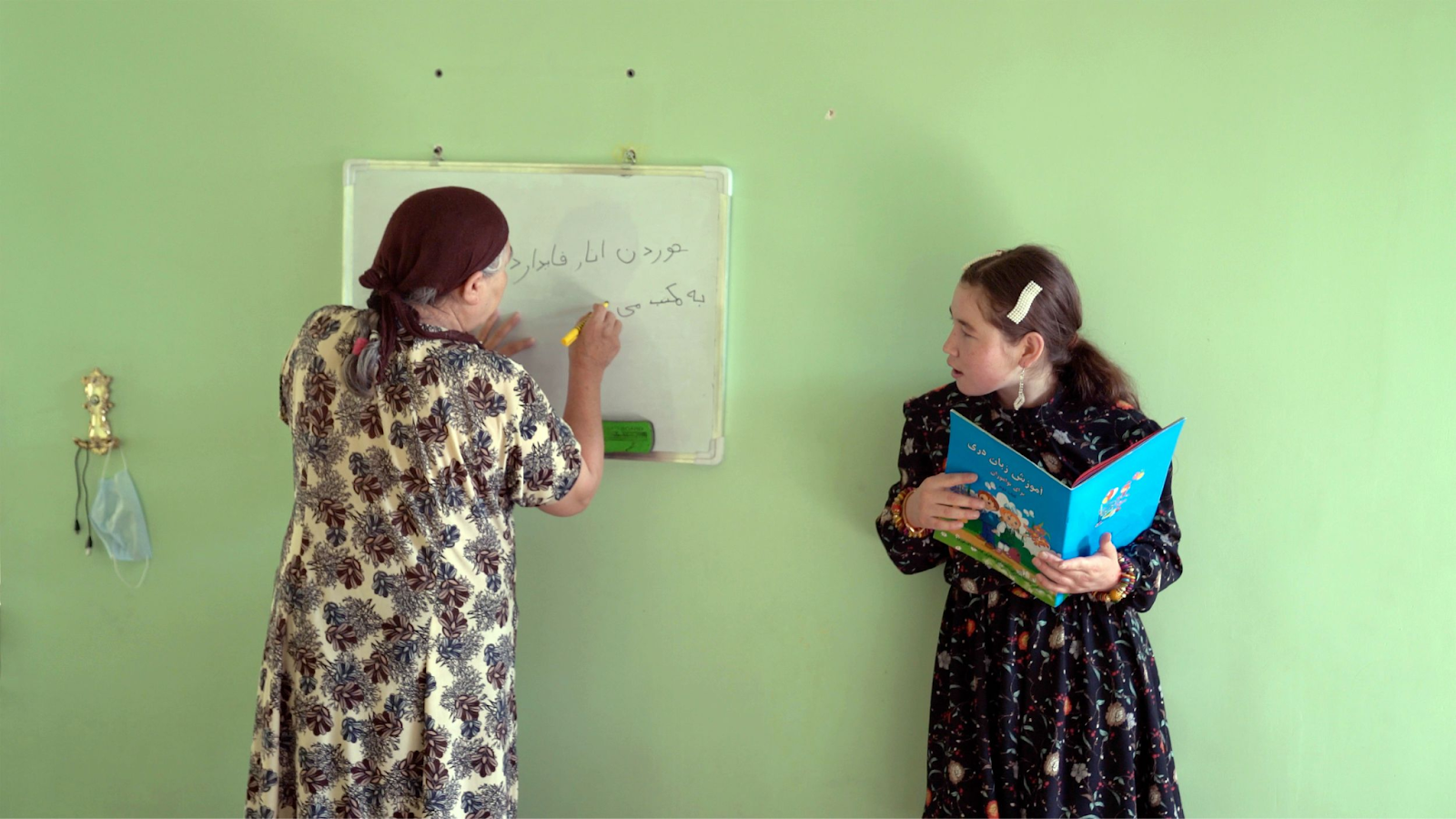
Also in "New Asian Currents," the Afghan documentary Writing Hawa (2024) begins with co-director Najiba Noori fleeing Kabul for Paris due to the Taliban's return. We realize that the "images of home" we are about to see represent a reality that has already vanished for both the viewer and the filmmaker. The film initially aimed to record the life of the director's mother, Hawa, from her domestic life to her learning to read. However, the Taliban's takeover forced Najiba into exile.
After she left Afghanistan, her camera left with her. Subsequent footage was taken over by her brother (co-director Rasul Ali Noori). We observe a clear shift in perspective when the camera records the interior of the home without Najiba. Living in Paris, Najiba receives these transmitted images—both familiar and strange—and continues to remember her unreachable home through the editing process. We don't just imagine her sitting at a computer; the film often captures her smartphone screen during video calls with her mother and the television screens broadcasting news of home. Writing Hawa demonstrates a creator losing their familiar "frame" and finding a new one.
Mini-DV Travelogue
Beyond the "Palestine—Memory of the Land" programme—which directly addressed Palestine through works spanning from the 1980s to the present, covering land memory, culture, and history—current responses to the situation by Palestinian creators were also evident in the "New Asian Currents" and International Competition sections. With Hasan in Gaza (2025), which premiered at the Locarno Film Festival and won the Grand Prize in the International Competition at YIDFF, is the "oldest" new Palestinian documentary I have seen in recent years. It is the least direct in filming the present, yet it feels startlingly relevant, almost as if it were about the here and now.
Kamal Aljafari, a master of archival imagery, sourced the material for this film from a "travelogue" he shot on a Mini-DV camera in 2001. At the time, he had traveled to the Gaza Strip to find a former cellmate, accompanied by a local guide named Hasan. Aljafari repeatedly emphasizes that all the footage in the film has long existed; it is a personal story and history that required little editing or structural intervention. He only recently rediscovered these images in his digital archives and remembered their existence.
Interestingly, Aljafari retained the original folder name from his computer database as the film's title: "With Hasan in Gaza." This type of labeling—noting the "who, what, when, where, and why"—combined with the medium of Mini-DV tape, perfectly captures the state of private, domestic image preservation and archiving. Consequently, the act of watching the film becomes an opening of dusty, personal archival files. By screening these private images publicly today, the film serves as an affirmation of the nominal and substantive existence of the "people, events, time, place, and objects" of Gaza.
The concept of the "screen within a screen" discussed earlier finds its manifestation in With Hasan in Gaza through an archival frame that preserves a twenty-year time lag. It is defined by the specific texture of Mini-DV, the gaze of a younger Aljafari just beginning to learn the craft of filming and recording, and a "vacuum" of Gaza's space-time that stands in stark contrast to its current state. Precisely because Aljafari recorded in the form of a casual "travelogue," we see within this Mini-DV screen children waving at the camera, expressing themselves, and even asking to be included in the frame. Both the person behind the lens and those in front of it are acutely aware of the camera's presence and the mnemonic function of that small screen.
To a certain extent, With Hasan in Gaza preserves "imperfect" footage—the waiting periods during the journey and the idle moments between putting the camera down and picking it up again. This continuity of time and the extension of space within it affirm the existence of a three-dimensional reality. Those faces, which may no longer exist, and that land, which has been nearly erased geopolitically, are forever remembered within the labels of a personal database. In the space-time constructed by the continuous zooming in and out and the rhythmic rising and falling of a handheld camera, they remain vacuum-sealed within the Mini-DV textured frame of the past—standing in defiance against the violence unfolding in the present.
Broken Satellite Maps
A Stone's Throw (2024) utilizes Google Maps satellite imagery to manifest a homeland that can never be returned to. The map pinpoints "Kirkuk Beach"; the overhead satellite view zooms in and out, shifts left and right, and focuses deeper and deeper as the scale shrinks. We enter the spaces of streets and alleys, drifting along the roads. As we find a path to "walk" forward, the lag in internet transmission and the non-synchronous nature of the maps cause "broken oceans" and frozen frames, with space frequently warping and deforming. A voiceover reads aloud individual reviews left on Google Maps landmarks; these alienated words and the incoherence of the visuals construct a screen suspended between the real and the virtual—a viewfinder that serves as the creator's current passage to a familiar place.
In A Stone's Throw, other images are overlaid upon the satellite maps. One crucial archival image used is a black-and-white photograph of the construction of the Kirkuk–Haifa oil pipeline, which began in the 1930s on the coast of Haifa. At first, we see a crowd on a blurry beach; then, the voiceover prompts a wider view, revealing the full photograph: a long oil pipeline stretching from the shore inland, surrounded by clusters of Arab workers. The movement on the screen zooms in on different workers, finally focusing on one specific group, magnifying until the image becomes a massive, coarse matrix of dots. The silhouettes of the human forms nearly vanish, making us acutely aware of the exhaustion of archival imagery and the limits of memory. Yet, simultaneously, as the screen continues to enlarge these pixels, they form an entire field of black, white, and gray dots. What was once a photograph occupying the screen gradually feels as though we are falling through the screen and into the photo itself. At the terminus of the still photograph, the dynamic screen action—the zoom—opens up an image of a different texture entirely. It creates a channel, allowing the viewer to fall into a space-time that does not exist in reality, thereby addressing what direct recording cannot.
Conclusion: Passages and Connections within the Screen
In What Did You Dream Last Night, Parajanov?, the director's mother opens a window during a video call. As the camera zooms in, the exterior world becomes a blown-out white block. The viewer realizes that seeing "reality" purely through visual records—especially an external reality where one is absent—is impossible. The only way to "see" is to reconstruct one's own reality between the actual footage and the lagging satellite or video images.
When creators attempt to interact "indirectly" with an absent or vanished reality, imagination serves as the bridge. For creators in diaspora, the "screen" is a place to live. Borrowing from Theodor Adorno: "For a man who no longer has a homeland, writing becomes a place to live." If we replace "writing" with "the screen," it becomes a "place" (space). This place is not just the virtual cloud space built by these concepts, but a process: from looking at an absent homeland through a viewfinder, to editing on a computer, to finally screening on a large cinema screen worldwide. They travel through the cracks of these connections, allowing their home and identity to live.