她們,掉下去了:《千禧曼波》與《尼羅河女兒》的音畫時空縫隙
She and Her Fell Down, into the Audio-Visual Spatio-Temporal Gap in Millennium Mambo and Daughter of the Nile
❍ This article was originally published in Chinese on Funscreen, Issue 763, 2024.
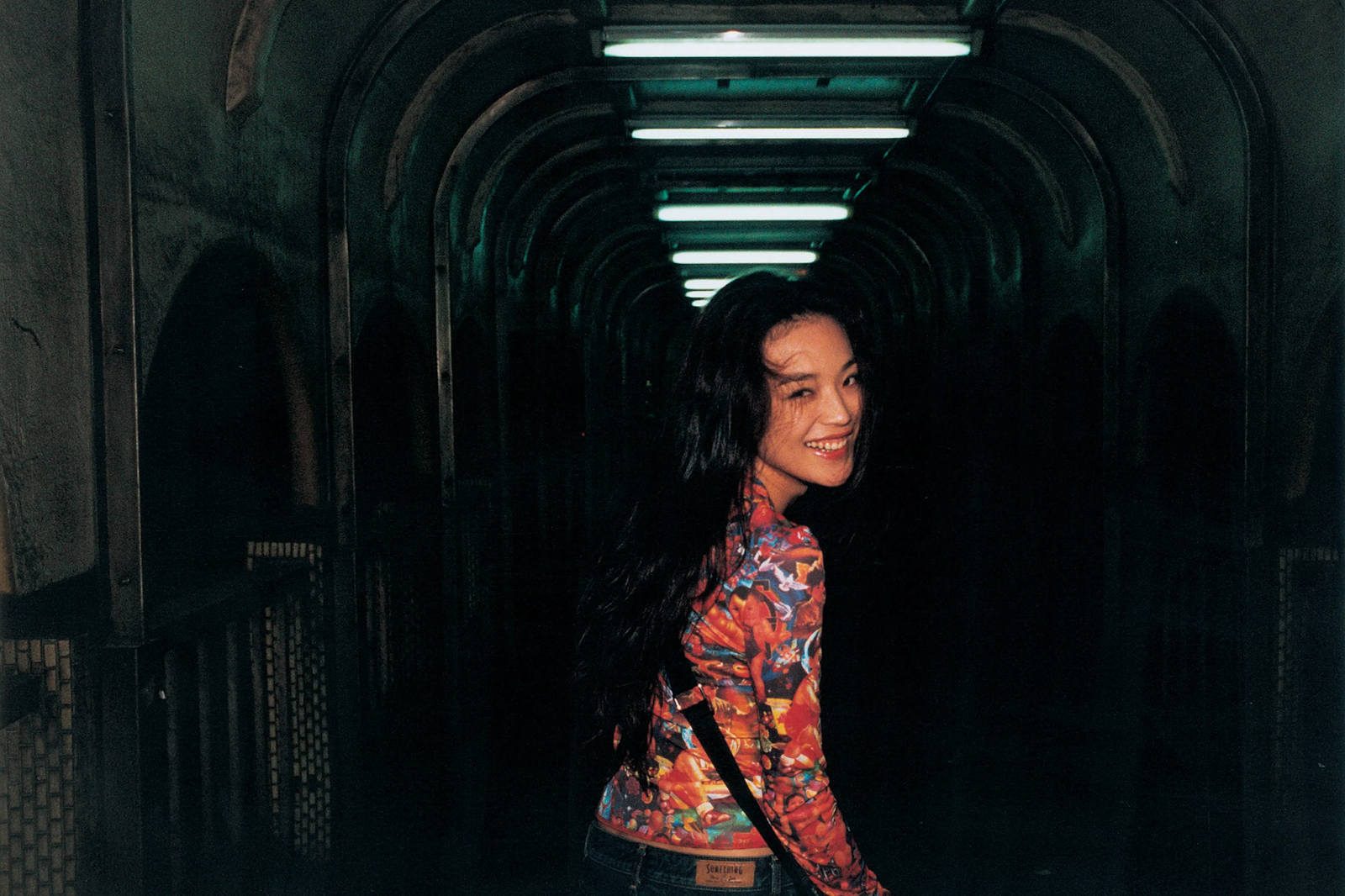
"Hao-hao often scribbled notes to tell her, they belonged to different worlds. He said, 'You fell from your world into mine. That's why you don't understand my world.'"
So speaks Vicky's voice-over. She sits on the floor, drained of strength, inhaling Hao-hao's methamphetamines.
It has been 24 years since the turn of the millennium—the year of my birth. Looking back now at Millennium Mambo (2001), a film I have seen countless times, I feel I have finally found "her"—or rather "them"—who "fell out" or "fell down" during that era. Standing on the tectonic rift between the 20th and 21st centuries, someone fell; they fell out of their own world and into the gap of space and time.
Vicky in Millennium Mambo was not Hou Hsiao-hsien's first foray into the emotions of the Millennial generation or fin-de-siècle sentiments. As early as Daughter of the Nile (1987), Hou collaborated with screenwriter Chu Tien-wen to craft a story about the end of the 20th century moving toward the 21st. What ingeniously links the "Millennium" and the "Mambo" in its audio-visual expression is Vicky's voice-over, recollecting the past from years later. Incidentally, Daughter of the Nile marked Hou's first use of a female voice-over for narrative purposes. This technique was later used more extensively and freely in A City of Sadness (1989), Good Men, Good Women (1995), and finally Millennium Mambo. I wish to emphasize that any discussion regarding the significance of the "Millennium" in Millennium Mambo is almost impossible without referencing Daughter of the Nile.
The classic opening shot of Millennium Mambo requires little introduction: the misty glow of fluorescent lights on the Zhongshan Pedestrian Bridge stretching endlessly forward, the misalignment between the bridge's vault and the swaying frame, and Vicky repeatedly looking back while running forward—"She couldn't escape; she always came back." A kinetic energy of flight and departure is trapped. At whom does she look back? Toward where is she running?
This article seeks to analyze the relationship between narrative technique and audio-visual elements in Hou's treatment of the fin-de-siècle and the Millennium in these two films. Through this, we might re-locate those Millennial characters who "fell into another world" or into the gaps of time. Within the gaps of the late 20th century, we observe the time-lag experienced by characters, the gap between image and sound, the dissociation of personal identity, and the repetitive, cyclical "entrapment" within the narrative structure.
Another World Built by Their Voices
In the narration of Millennium Mambo, Vicky refers to herself in the third person throughout. The "I" of ten years later remembers the "she" of ten years ago, creating a peculiar estrangement—a dissociation of identity. It is as if a part of "me" fell out of my own body at that time and became "her." Consequently, in every monologue segment, we sense a feeling of alienation and rupture, alongside a distinct time-lag: the year 2001 and 2011.
In Daughter of the Nile, the opening shows Hsiao-yang (played by Lin Yang) staring into the distance, narrating events from her third year of junior high. She then reads a passage from the manga Daughter of the Nile:
The time was three millennia ago. A spell has brought me, Carol, to this ancient world. I've fallen in love with Memphis, the young pharaoh. But since my disappearance from the 20th century, my brother, my boyfriend Jimmy, and others have been desperately searching for me…
Hsiao-yang is simultaneously herself in the late 20th century and Carol from 3,000 years ago. Here, too, the voice-over narrator possesses two identities, existing in two dimensions at once through the effect of audio-visual separation.
This distance between "I" and "she" serves as the primary anchor for understanding the fin-de-siècle and Millennial sentiments in both films. In Millennium Mambo, after a sequence of dancing, the film cuts directly to Vicky and Hao-hao having sex in a room. The visuals are a murky blue, as if underwater or in a dream. Their faces are inverted, and light filters through orange-yellow glass beaded curtains, creating shimmering spots of light on their bodies—blurred and indistinct. The camera seems positioned in the gap between reality and dream, voyeuristically observing this sex. For Vicky, the relationship with Hao-hao is both real and illusory. "She" is hurt by him countless times, yet she always returns; she cannot escape. Thus, this sex scene is the body of "she" as seen through the eyes of the narrator "I." It happened; her body experienced it at the turn of the millennium, yet it feels as though something is in between, as if it is incomplete. As Vicky describes the experience at the end of the film: "Once, when she was making love with Hao-hao, she suddenly had the feeling that Hao-hao was just like the snowman. He would vanish as soon as the sun came up. Making love was sad that day. Even years later, she still remembered it." The way the bodies of "I" and "she" remember and feel is dissociated, trapped between reality and phantom dreams—this is the so-called "Mambo rhythm" and perception of the Millennium.
In Daughter of the Nile, after a police raid on the restaurant of Hsiao-fang (played by Jack Kao), the camera cuts to an empty shot of the Taipei sky, accompanied by the eponymous theme song sung by Lin Yang. Hsiao-yang sits dazed on the sofa, wearing her Walkman, deaf to the shouts of the outside world. This shot perfectly encapsulates Hsiao-yang's inner world. The music we hear is what she is playing on her Walkman—sung by the actress herself—acting as Hsiao-yang's alter ego, Carol. It is her inner world: "Can the river of time stop flowing for me? Lost in time and space, searching for love. The flowing River Nile gently calls me. Distant memories of my own time, a slumber of a thousand years, silently lingering, slowly tempting, your golden smile, our promise of three lifetimes together." This is a fantasy world independent of the chaotic life Hsiao-yang leads in the late 20th century—a story of desolated love in another world. The "she" of 3,000 years ago sings, serving as both diegetic and non-diegetic sound, while the "she" of the 20th century listens and imagines, quietly building her own Babylon.
"I" and "she," "I" and "Carol"—their voices provide them with another body, identity, perception, and imagination. I am reminded of what Chu Tien-wen wrote at the end of "Fin-de-Siècle Splendor": "The abysmal blue of the lake tells her that the world men have built with theories and systems will collapse, and she with her memory of smells and colors will survive and rebuild the world from here." (Chu, 393-394)
Trapped in the fin-de-siècle, Vicky and Hsiao-yang must depart from the blur of reality—whether leaving Hao-hao's world or the 20th century of their fathers and brothers. They move into another body and voice, using a hazy, subtle sensory memory to rebuild their world.
The Kinetic Energy Running Out of the Temporal Gap
Another temporal gap of the fin-de-siècle is manifested in the narrative and editing. In one scene of Millennium Mambo, after an argument with Hao-hao, Vicky packs her bags to leave. Hao-hao slams the door. Without a fade or a black screen, Hou cuts directly to Vicky working at a hostess club. Her voice-over narrates how she ended up there after failing to pay rent, and how she met Jack. Later, she meets the Japanese brothers, and the screen shifts to the snowy landscape of Yubari, Japan. This entire sequence is temporally blurred. Vicky has seemingly left Hao-hao, but we do not know for how long; she is in Japan, but we do not know when this occurs on the timeline. Between events and spaces, there are constant rifts. The only thing stitching these fragments together is the audio bridge of Vicky's voice-over. These fragmented events exist in Vicky's memory of the Millennium without a clear chronological axis; they exist only as points of light, flickering in isolation.
We also notice that Millennium Mambo is filled with scenes in various pubs—fragmented, decontextualized parties that fill the temporal gaps between memories. Hou usually presents these in medium close-ups with shallow focus, flattening the environment. The camera pans or follows characters through the space, allowing us to feel the restricted, revolving, trapped perception of time during the Millennium. This makes the empty shots of Yubari feel distinct. The shot looking out from the car window onto the snow is one of the few images in the film with spatial depth and a sense of forward motion. In these rare moments, the "she" in Vicky's story escapes the spell-like, hypnotic cycle and enters a different space-time—much like her running on the pedestrian bridge. These moments suggest a kinetic energy of "falling out," where time extends forward. In these frames, she seems to say: I am here, I am moving forward, I can walk into the Millennium with the rest of humanity, no longer trapped in the "spin" of the nightlife.
In Millennium Mambo, time is like a series of neon pulses, flickering without context. In Daughter of the Nile, however, time is a flowing river that washes through the narrative and transitions. Hou inserts establishing shots of Taipei from high vantage points or street-level views of traffic. The pale mountain, the neon signs of KFC—these elements of late 20th-century modernization are stable, while people pass through the frame.
At the end of Daughter of the Nile, following a bleak shot of the mountain, Hsiao-yang again recites the manga: "In the Bible, the prophet Jeremiah prophesied that this city would become desolate. A dry desert, a savage wilderness with no inhabitants. No people. The mysterious capital, Babylon." One could say that the flow of time in Daughter of the Nile is drawn through these external urban landscapes, and Hsiao-yang's fin-de-siècle perception is tied closely to the city of Taipei.
Thus, comparing the two films is illuminating. In Daughter of the Nile, people on the cusp of the Millennium perceive change through their environment and the lives of the men around them, using fiction to imagine a new world. By Millennium Mambo, humanity has truly crossed into the 21st century. Vicky's experience is more internal and private. In the flat, compressed spaces of pubs and apartments, Vicky is the percipient. She loves, wanders, and hurts personally, struggling to release her kinetic energy within the gap of the centuries.
The Era without Me
In the past, when watching these two films, I always felt sorry for Vicky and Hsiao-yang, seeing them as tragic figures trapped at the turn of the century. Now, I finally understand that Hou Hsiao-hsien and Chu Tien-wen's audio-visual experiments gave them freedom, mending the time-lag between eras. This is why, starting with Daughter of the Nile, Hou moved away from the male autobiographical voice-over toward a female voice that opens up an imaginary, non-rational world. By Millennium Mambo, this voice has condensed into another "she"—a version of herself born from the act of "falling." Vicky is free because this "she" exists; because "she" felt the sex and the snow of Yubari so deeply, she truly remembers the physical sensation of being "A Pure Person."
The final shot of Millennium Mambo rests on a snowy street at night—a rare shot with depth. Daughter of the Nile ends with a fade-out of the Taipei skyline. Both films are about a final farewell. In the era without me—in these frames where the "I" (me) is not present—"I" becomes "she." The frame becomes transparent, and sound becomes the anchor of memory. That year in the snow of Yubari, that mysterious city of Babylon—she and her, they fell, and thereafter settled into the gap of space-time, free and pure. I no longer feel sad for them.
Reference
Chu, Tianwen. "Fin de Siècle Splendor." Translated by Eva Hung. The Columbia Anthology of Modern Chinese Literature, edited by Joseph S.M. Lau and Howard Goldblatt. New York: Columbia University Press, 2007.